
New editorial guide · Written 28 October 2026. This is new writing, not a recovered historical article.
A military ceremony is designed to look exact. A movement ends at a particular moment; another person takes over a task without breaking its rhythm. To a visitor, the result may appear almost effortless. For a documentary filmmaker, that surface raises a useful question: what preparation, judgment, and experience does the ceremony make visible, and what does it leave outside the frame?
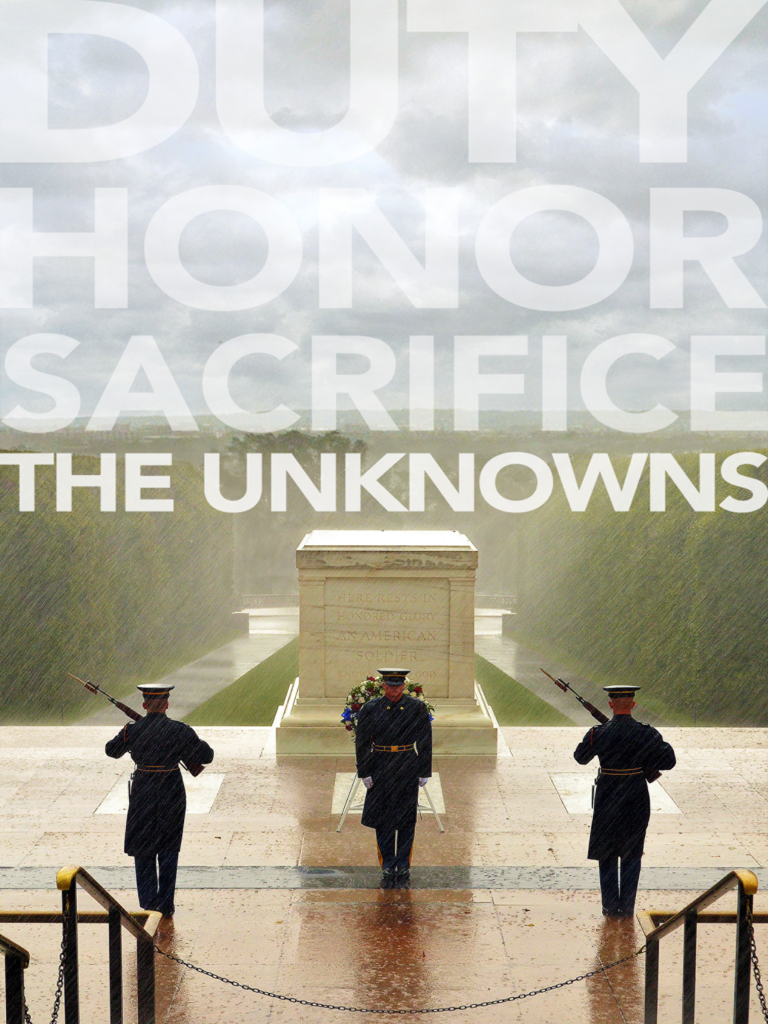
Time To Kill Productions’ historical projects provide two connected starting points. The Unknowns concerns the Tomb of the Unknown Soldier and its Sentinels. Honor Guard widens the subject to training and ceremonial service within the 3rd U.S. Infantry Regiment. This guide uses those documented subjects to explore nonfiction storytelling. It does not reconstruct scenes, claim new access to the productions, or substitute imagined interviews for reporting.
Find the human question inside an institutional subject
An institution has a name, a history, and a public purpose. A person has a task to complete, a standard to understand, and decisions to make under particular circumstances. A documentary often becomes more legible when the audience can follow that smaller unit of experience. The institution supplies context; a clearly understood responsibility gives the viewer something concrete to observe.
That does not require manufacturing an individual hero. Consider a hypothetical training sequence: someone rehearses a movement, receives a correction, and tries again. The meaningful change might be a better understanding of a shared obligation rather than a spectacular personal victory. An editor can preserve that modest scale instead of forcing the material into a triumph narrative that the recorded evidence does not support.
Distinguish access from understanding
Access can make unusual images possible, but an unfamiliar location is not an explanation by itself. A close shot of equipment may be visually interesting while telling the audience little about its use. The filmmaker still needs to establish what is happening, who is responsible, and why a particular detail matters to the activity being documented.
Biola University’s December 2020 report on Honor Guard describes Ethan Morse and Neal Schrodetzki’s collaboration, the series’ access to training, and Sam Elliott’s narration. Those are useful production facts. They are not permission to assume that every observed event represents every soldier’s experience. A precise account keeps the distinction between this production’s material and broader institutional claims.
Let repetition reveal a difference
Repetition can become tedious when a sequence simply repeats information. It can become revealing when the audience knows what to look for. A first pass establishes the task. A later pass might expose a correction, a change in confidence, or the coordination between participants. The editor’s job is to give those differences enough space to register without explaining every gesture twice.
Watch the relationship between shot size and duration. A wide view can establish the shared geometry of an activity. A closer view can reveal a hand position or a glance, but it may conceal the rest of the group. Returning to the wide view allows the detail to regain its place in a collective action. Neither distance is inherently more truthful; each makes different information available.
Show preparation without pretending to know a person’s mind
It is tempting to describe a silent face as anxious, proud, or determined. Those descriptions may feel plausible and still go beyond what the footage establishes. A stronger approach separates observation from interpretation. The person checks a uniform, waits for an instruction, or repeats an action. If the film supplies an interview about that moment, the viewer can connect the visible action with the participant’s own explanation.
Without that explanation, uncertainty can remain part of the scene. The audience does not need an emotional label on every image. Showing the practical work clearly can communicate concentration while leaving room for experiences that a camera cannot directly record. Restraint is especially useful when the subject carries public expectations about courage, grief, or duty.
Build context at the moment it becomes useful
Historical background helps when it answers a question the sequence has already made meaningful. A long introductory lecture can delay the viewer’s encounter with the people and work. The opposite mistake is to withhold essential context until the audience has misunderstood the activity. The useful balance depends on what a particular scene requires, not on a fixed formula for documentary openings.
For a subject connected to Arlington, a brief explanation of a memorial’s role might be necessary before a ceremony can be understood. A detailed institutional timeline may be better offered in a companion article. The filmmaker profile and the recovered project material provide different levels of context on this site; neither needs to replace the experience of watching the film.
Listen for work as well as words
Dialogue is only one source of information. Footsteps can establish a pace; an instruction can connect separate bodies in a shared space; a pause can make the duration of an action perceptible. These sounds can carry practical meaning before music is introduced. A useful viewing exercise is to ask what the scene already communicates through its recorded environment.
Music adds another layer of interpretation. Ask whether it helps a transition, sustains attention, or instructs the audience to feel a particular emotion. Those functions can overlap. A solemn subject does not automatically require continuous solemn scoring, just as a quiet passage is not automatically neutral. The choices deserve to be examined in relation to the actual scene.
Treat an interview as a perspective, not an all-purpose explanation
The Tango Alpha Lima interview with Morse and Schrodetzki, published December 23, 2020, discusses their Army service, partnership, and documentary projects. A production interview can help a viewer understand intention and process. It remains a different kind of evidence from the completed film, an independently documented historical record, or the experience of another participant.
Keeping those sources distinct improves a discussion. A filmmaker may explain what they hoped a sequence would achieve. A viewer may still find that its pacing or framing produces a different effect. That disagreement can be specific and useful without inventing motives or dismissing the work that made the sequence possible.
Carry the questions into the next viewing
Before a discussion, divide a page into three columns: action, context, and interpretation. In the first, record only what the sequence visibly or audibly establishes. In the second, note information supplied by an interview, caption, or historical source. Use the third for your own response to the framing, duration, and soundtrack. The exercise can reveal where a confident conclusion depends on information that the scene itself never provides.
Compare those notes with another viewer’s account. If you agree about the action but disagree about its emotional effect, you have identified a question of interpretation. If you disagree about what happened, return to the sequence before building a larger claim on it.
After watching, identify one sequence you could describe without using an abstract word such as honor, sacrifice, or excellence. Name the action, the information supplied, and the formal choices that directed your attention. Then consider whether the larger idea emerged from those details or was mainly asserted through narration and music.
This approach allows respect for the subject and scrutiny of the filmmaking to coexist. It also connects the documentary projects with the historical film journal, where visuals, sound, performance, effects, and story are considered separately. The aim is not to reduce a documentary to a score. It is to make a judgment clear enough that another viewer can examine it.
The same questions about attention and timing can also be applied to interactive media. A documentary presents a recorded sequence, while a game responds to a player’s actions. To explore that difference, read our guide to sound and visual feedback in online games, which considers animation, audio cues, and accessibility.